Key Takeaways
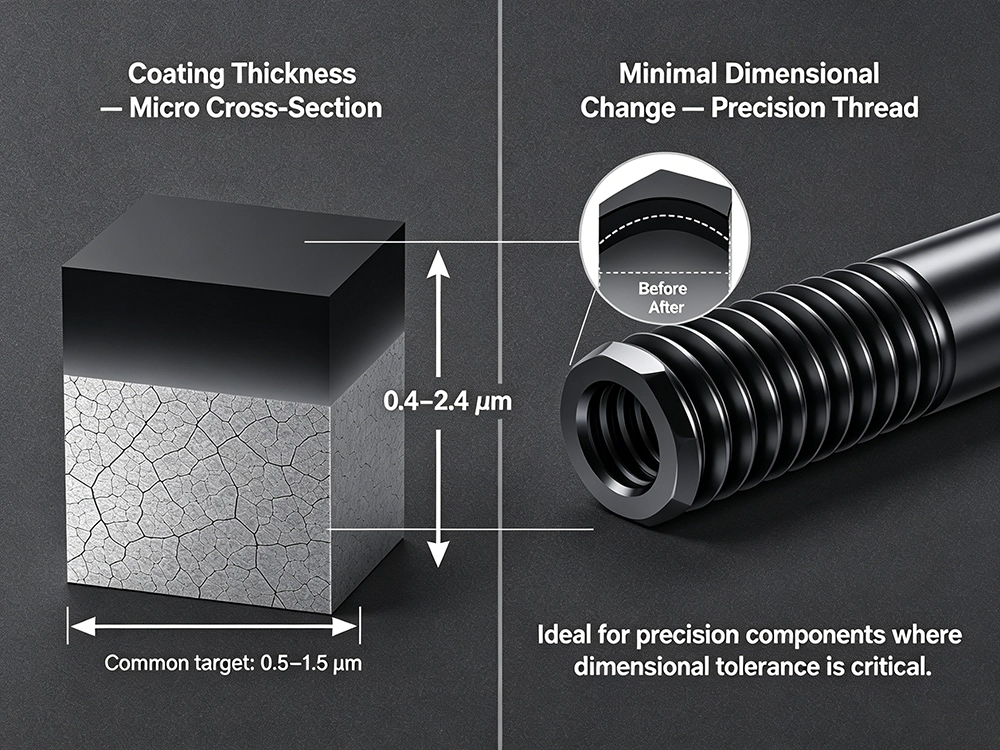
- Minimal dimensional change: Black oxide coating creates an extremely thin conversion layer, typically around 0.4–2.4 μm, with a common process target of approximately 0.5–1.5 μm. This makes it suitable for precision steel parts where thread fit, mating surfaces, and dimensional stability are critical.
- Corrosion protection requires sealing: The black oxide layer itself provides only limited rust resistance. Practical corrosion protection mainly comes from post-treatment, such as water-displacing rust preventive oil sealing after black oxide processing.
- Compatible steel materials: Standard hot black oxide is commonly used for carbon steel, low-alloy steel, wrought iron, cast iron, and ductile iron. Materials such as 304 and 316 austenitic stainless steel require a dedicated blackening process rather than the conventional carbon-steel hot black oxide route.
How Does the Blackening Coating Process Work on Carbon Steel Parts?
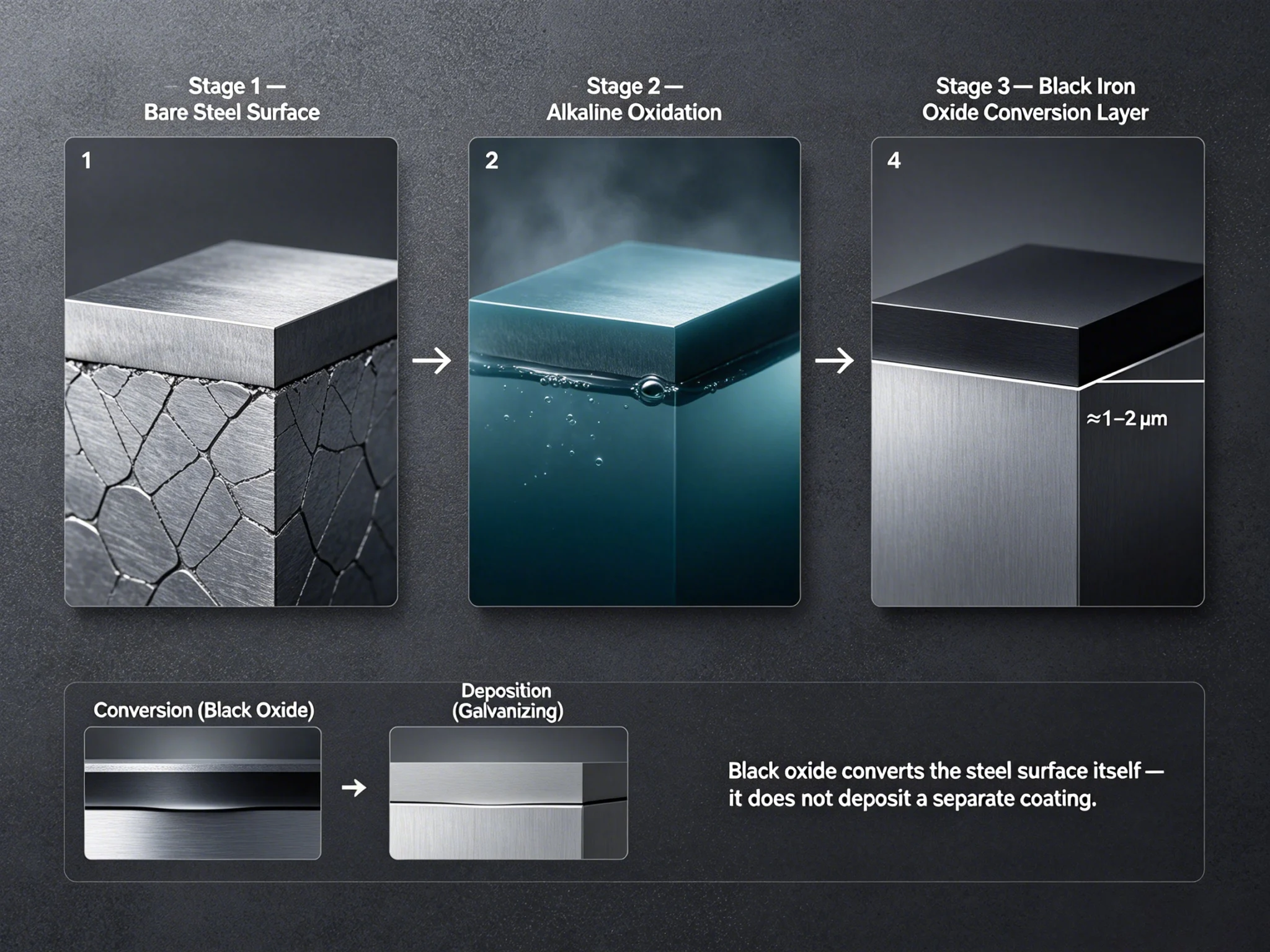
Hot black oxide processing is a chemical conversion treatment that transforms the surface of carbon and low-alloy steel parts into a thin black iron oxide layer through an alkaline oxidation process. Unlike plating or coating processes that deposit an additional material layer onto the part surface, black oxide modifies the existing steel surface to create a controlled conversion film.
Because the process produces a very thin oxide layer rather than a thick buildup, it has minimal impact on part dimensions. This makes black oxide suitable for precision steel components such as fasteners, locating pins, and machined parts where thread fit, mating surfaces, and assembly accuracy must be maintained.
What Temperature and Time Does Hot Black Oxide Processing Require?
Traditional hot black oxide processing for carbon and low-alloy steel typically operates at 141–152°C (286–306°F), with a common production range of approximately 140–150°C. The immersion time is usually around 5–60 minutes, depending on the steel grade, part geometry, surface condition, and required process control.
These parameters apply specifically to hot black oxide processing. Cold blackening or room-temperature blackening methods use different chemical systems and operating conditions, so their process data should not be directly applied to traditional hot black oxide treatment.
What Post-Treatment Is Required After Black Oxide Coating?
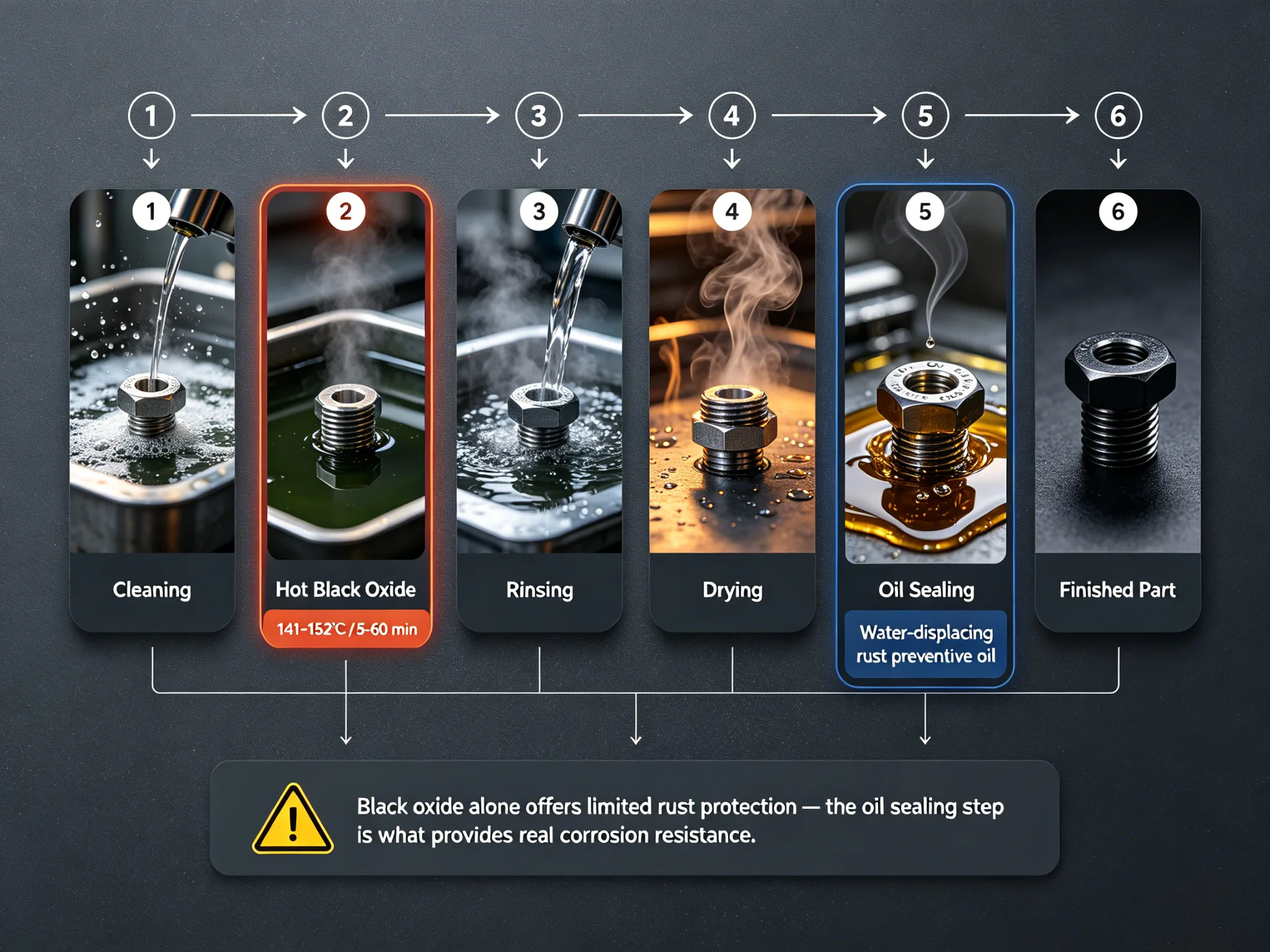
After black oxide coating, steel parts should be thoroughly rinsed, dried, and sealed to improve corrosion protection. The black oxide conversion layer itself provides only limited rust resistance, so a post-treatment such as water-displacing rust preventive oil is typically required for practical protection during storage, handling, and shipment.
A water-displacing preservative with performance equivalent to MIL-PRF-16173 Grade 3 may be used where applicable. Wax sealing can also be considered for applications requiring a drier surface feel or short-term protection, but it may affect surface friction, assembly behavior, and subsequent coating performance. For most precision steel components, oil sealing remains the standard post-treatment approach.
Which Steel Grades Are Suitable for Black Oxide Coating?
Conventional hot black oxide coating is mainly suitable for carbon steel, low-alloy steel, wrought iron, cast iron, and ductile iron. Common steel grades used for black oxide processing include:
- Q235 / 1018: Low-carbon steels commonly used for general machined components and fasteners.
- 45# steel / approximately 1045: Medium-carbon steel suitable for many mechanical parts requiring dimensional stability.
- 40Cr: A low-alloy steel commonly processed with black oxide for precision components.
- 20Cr, 35CrMo, and 42CrMo: Alloy steels that can be suitable for black oxide treatment depending on material condition, hardness, and application requirements.
Material suitability should be evaluated together with the steel grade, heat treatment condition, part geometry, and required surface performance before production. Stainless steels such as 304 and 316 require a separate blackening process rather than the conventional carbon-steel hot black oxide route.
Material selection is only one part of a successful black oxide program — process control, batch consistency, and post-treatment sealing all affect the final result. Learn more about our black oxide finishing service for carbon steel and low-alloy steel components.
Black Oxide Coating Specifications for Precision Steel Parts
Black oxide coating is defined by its thin conversion layer, minimal dimensional impact, and dependence on post-treatment for practical corrosion protection. The following specifications summarize the typical parameters used for precision carbon steel and low-alloy steel parts.
| Parameter | Typical Value |
| Coating thickness | 0.4–2.4 μm (common target: 0.5–1.5 μm) |
| Processing temperature | 141–152°C (286–306°F) |
| Immersion time | 5–60 minutes |
| Compatible substrates | Carbon steel, low-alloy steel, wrought iron, cast iron, and ductile iron |
| Post-treatment | Water-displacing rust preventive oil or equivalent sealing treatment |
Actual process results may vary depending on the steel grade, part geometry, surface condition, production batch, and customer requirements. Coating thickness and corrosion performance should be evaluated based on the specific application rather than treated as fixed values.
How Thick Is Black Oxide Coating and Does It Affect Tolerances?
Black oxide coating has minimal impact on part dimensions because it forms an extremely thin conversion layer rather than adding a thick deposited coating. This makes it suitable for precision steel components where thread engagement, mating surfaces, and assembly clearance must be maintained.
For applications with strict dimensional requirements, the final coating result should be evaluated based on the actual steel grade, part geometry, surface condition, and production batch. Black oxide is commonly selected for precision fasteners and mechanical parts because it provides a uniform black finish while preserving critical dimensional features. Dimensional impact isn’t unique to black oxide — every surface finish interacts differently with machining tolerances depending on coating type, thickness, and part geometry. For a broader look at this topic, see how surface finishing affects CNC machining tolerances.
Black Oxide Corrosion Resistance and ASTM B117 Testing
Black oxide coating provides a thin conversion layer that improves surface appearance and offers limited corrosion protection, but the final corrosion performance depends primarily on the post-treatment system. For carbon steel parts, rust prevention is typically achieved through sealing methods such as water-displacing rust preventive oil, combined with appropriate storage and packaging conditions.
When corrosion performance needs to be verified, testing should be evaluated based on the actual combination of substrate material, black oxide process, sealing treatment, and application requirements. ASTM B117 salt spray testing may be used as part of this evaluation process, but corrosion results should not be generalized across different materials or finishing systems.
Performance claims such as specific hours of salt spray resistance should only be made when supported by relevant test reports and the exact process conditions used for the tested parts.
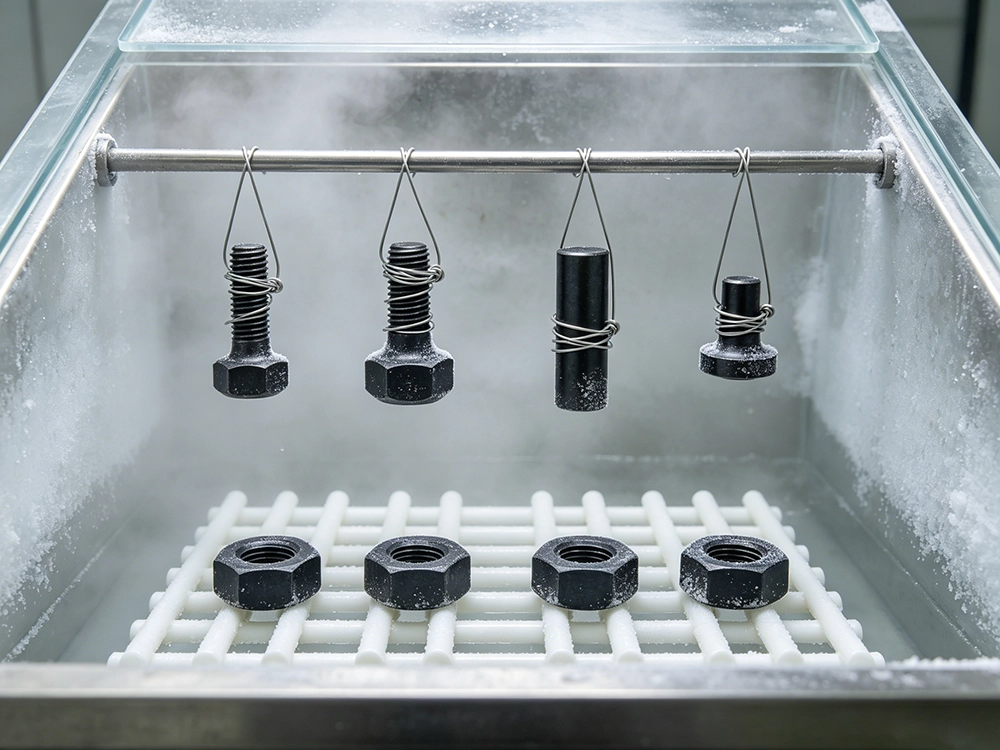
Black Oxide vs. Zinc Plating vs. Powder Coating for Automotive Fasteners
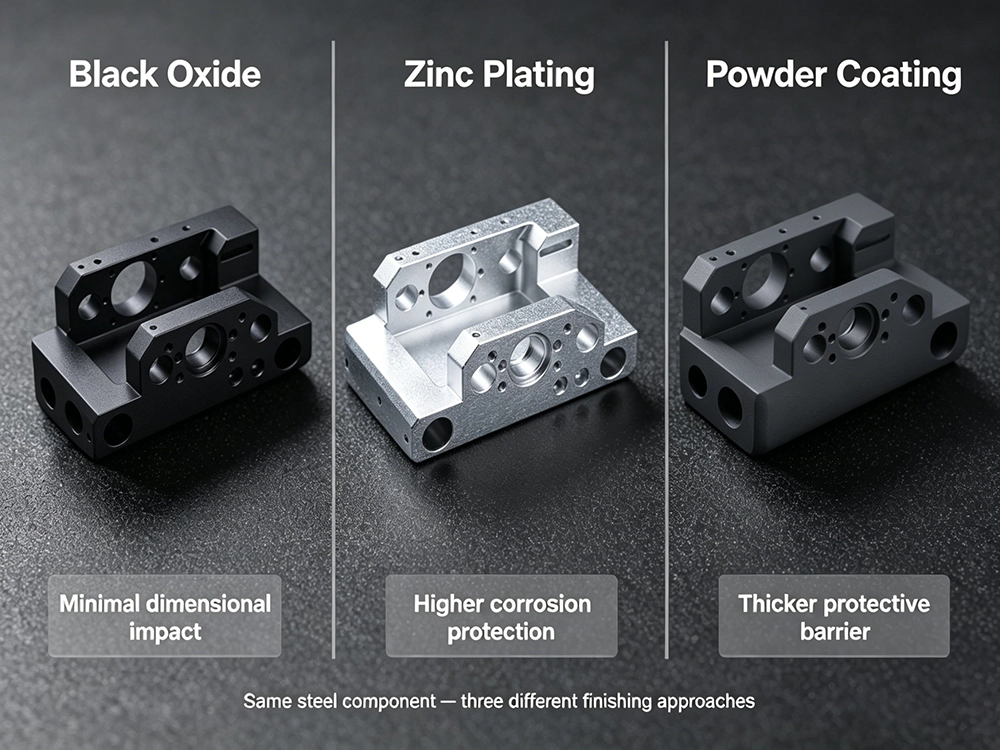
Choosing the right surface finish for automotive fasteners depends on the balance between dimensional control, corrosion protection, appearance requirements, and application environment. Black oxide, zinc plating, and powder coating each provide different performance advantages.
Black oxide is typically selected for precision components where minimal dimensional change is important. Zinc plating is often preferred when stronger corrosion protection is required, while powder coating is generally used for applications that need a thicker protective barrier and greater surface coverage.
| Process | Best Fit | Dimensional Impact | Corrosion Protection Source |
| Black Oxide | Precision fasteners, threads, and components requiring tight dimensional control | Very low due to thin conversion layer | Mainly provided by post-treatment such as oil sealing |
| Zinc Plating | Fasteners exposed to higher moisture or corrosion environments | Greater than black oxide due to thicker deposited coating | Zinc coating itself provides corrosion protection |
| Powder Coating | Components requiring strong surface coverage and protective appearance | Higher due to thicker coating build | Protective polymer coating layer |
For automotive fastener programs, the optimal finish should be selected based on the part function, assembly tolerance, exposure conditions, and customer requirements rather than applying one finishing method to every component. To see how these tradeoffs play out in practice, see how we blackened steel turned parts for automotive fasteners.
Black Oxide vs. Zinc Plating for Fasteners
Black oxide and zinc plating are selected for different fastener requirements. Zinc plating generally provides stronger corrosion protection, while black oxide offers better dimensional stability for precision components where coating buildup must be minimized.
| Comparison Factor | Black Oxide | Zinc Plating |
| Corrosion protection | Mainly depends on post-treatment such as oil sealing | Zinc coating itself provides corrosion protection |
| Dimensional impact | Very low due to the thin conversion layer | Higher because zinc is a deposited coating with greater thickness |
| Suitable applications | Precision fasteners, threaded parts, and components requiring tight fit control | Fasteners exposed to moisture or environments requiring higher corrosion resistance |
| Main selection priority | Dimensional accuracy and assembly consistency | Long-term corrosion protection |
For automotive fasteners, black oxide is often considered when thread fit and assembly tolerance are critical, while zinc plating is typically selected when environmental exposure and corrosion protection are the primary concerns.
Black Oxide vs. Powder Coating for Precision Parts
Black oxide and powder coating are designed for different application priorities. Black oxide is better suited for precision steel parts where dimensional stability is critical, while powder coating is typically selected when thicker surface protection and appearance coverage are more important.
| Comparison Factor | Black Oxide | Powder Coating |
| Coating type | Thin chemical conversion layer formed on the steel surface | Thick protective polymer coating applied onto the surface |
| Dimensional impact | Minimal, suitable for tight-tolerance features | Greater due to higher coating thickness |
| Suitable applications | Threads, mating surfaces, precision mechanical components | Exterior parts and components requiring stronger surface coverage |
| Main advantage | Maintains dimensional accuracy while providing a uniform black finish | Provides a stronger physical barrier and broader appearance options |
For precision automotive components, black oxide is often preferred when assembly accuracy and tolerance control are critical. Powder coating is generally more suitable when protective coverage and surface appearance take priority over dimensional control.
Can Stainless Steel Be Black Oxide Coated?
Standard hot black oxide processing for carbon and low-alloy steel is not directly suitable for 304 and 316 austenitic stainless steel parts. Stainless steel has different alloy characteristics and surface properties, so it requires a dedicated blackening process rather than the conventional carbon-steel black oxide route.
When stainless steel fasteners or precision components require a black surface finish, the finishing method should be selected based on the stainless grade, appearance requirements, dimensional requirements, and application environment. The standard hot black oxide process used for carbon steel should not be transferred to stainless steel without confirming process compatibility.
Black Oxide for High-Hardness Fasteners: Hydrogen Embrittlement Considerations
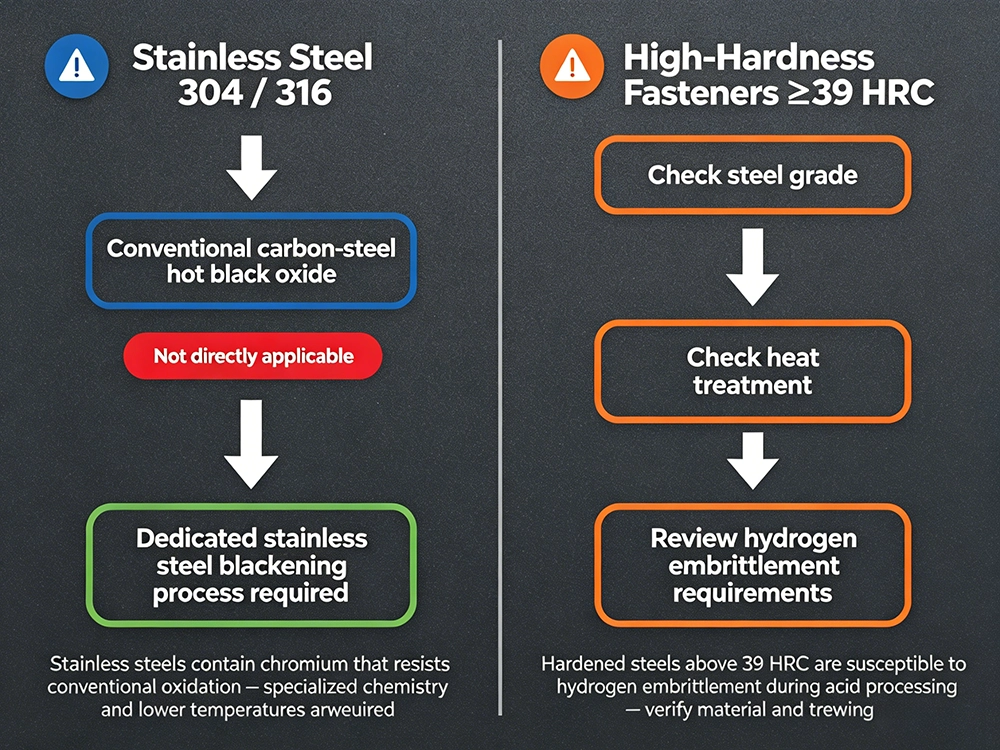
High-hardness steel fasteners require additional process review before black oxide treatment. For steel parts with hardness of 39 HRC or above, buyers should confirm the material condition, heat treatment status, and whether hydrogen embrittlement prevention measures are required.
For high-strength or highly stressed components, the black oxide process should be evaluated together with the part’s mechanical requirements and service conditions. During quotation and sampling, key information such as steel grade, hardness level, heat treatment condition, and required stress-relief or hydrogen embrittlement treatment should be reviewed to ensure the finishing process is suitable for the application.
Summary
Black oxide coating is a practical surface treatment for carbon steel and low-alloy steel parts where dimensional stability, consistent appearance, and tight assembly requirements are important. Its thin conversion layer makes it suitable for precision fasteners, machined components, and mechanical parts where maintaining original part geometry is a priority.
However, black oxide should be selected with a clear understanding of its limitations. The conversion layer itself provides limited corrosion resistance, so effective rust protection depends on the sealing treatment and application conditions. In addition, conventional hot black oxide processing is not a direct solution for 304 and 316 stainless steel, which require a dedicated blackening process.
For precision steel components, the appropriate black oxide solution should be evaluated based on material grade, hardness condition, dimensional requirements, post-treatment method, and final application environment.
Black Oxide Quick-Reference Table
| Item | Value / Conclusion |
| Typical coating thickness | 0.4–2.4 μm (common target: 0.5–1.5 μm) |
| Hot black oxide processing temperature | 141–152°C |
| Immersion time | 5–60 minutes |
| Compatible materials | Carbon steel, low-alloy steel, wrought iron, cast iron, and ductile iron |
| Is post-treatment required for corrosion protection? | Yes. Sealing with rust preventive oil or equivalent corrosion protection treatment is required |
| Can 304/316 stainless steel use standard hot black oxide? | No. A dedicated blackening process is required |
| High-hardness parts above 39 HRC | Require confirmation of hydrogen embrittlement prevention and related process requirements |